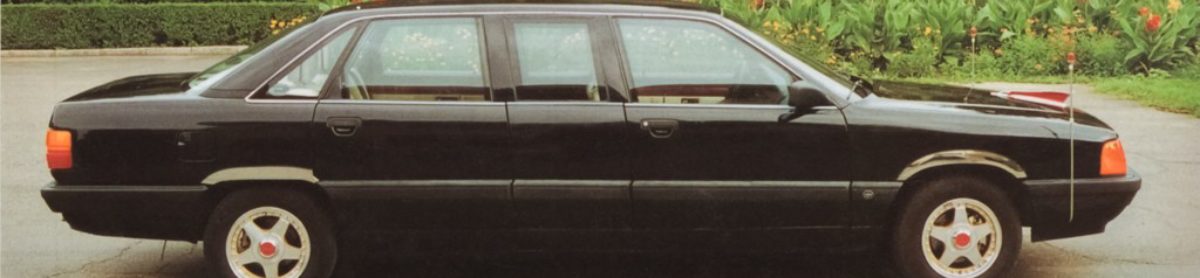

If you drive through Switzerland today, you will come across Chinese car brands more and more often. BYD, Xpeng, MG, or Nio are no longer exotic.
While Chinese new cars are increasingly dominating the streetscape, there is one type of vehicle that you practically never see: Chinese classic cars. This is hardly surprising, because according to current knowledge, there is only one specimen in Switzerland – a Hongqi (“Red Flag”) CA773 from 1975.

The cradle of China’s automotive industry
The first Chinese state limousines were built with the support of Soviet engineers and were based on Russian models. Even the distinctive red flag on the grille of the Hongqi may have been inspired by the Soviet ZIS-110.

The Hongqis are built by FAW (First Automobile Works) in Changchun – China’s first major automobile manufacturer and the cradle of the Chinese automotive industry. Today, FAW also produces vehicles from Volkswagen, Audi and Toyota for the Chinese market in long-standing partnerships.
Today, this development seems almost paradoxical: Russian automobiles hardly play a role on the world market, while China has long since overtaken its former mentors and is now one of the leading automotive nations. Especially in the field of electromobility, Chinese manufacturers are setting new standards worldwide.
The Hongqi thus stands not only for China’s leadership, but also for the origin of an automotive industry that is now in the process of reorganizing the balance of power on the world market.
From state car to design icon


The Hongqi has been the representative state limousine of China since the founding of the People’s Republic of China. To this day, it is the most prestigious automobile brand in the country. The striking front end is particularly striking. The characteristic grille and twin headlights still characterize the brand’s flagship models.
The current state vehicle, in which China’s President Xi Jinping travels on official occasions and military parades, deliberately adopts this historical design language. Similar to BMW or Mercedes-Benz, Hongqi now has a wide range of models – from affordable production vehicles to exclusive luxury and state limousines. The iconic front design is reserved for the top models and is deliberately reminiscent of the legendary vehicles of the 1960s and 1970s.
Why choose the smaller CA773 instead of the Big Hongqi CA770?

Only 291 examples of the Hongqi CA773 were built between 1969 and 1976 (285 according to other sources). This makes it significantly rarer than the well-known CA770, of which 847 vehicles were built between 1966 and 1981. I deliberately chose the CA773 – for two reasons. On the one hand, the body is about 40 centimeters shorter than the CA770 at 5.58 meters.

This was made possible by shorter overhangs and the omission of the partition between the chauffeur and the party functionaries in the rear. These 40 centimetres were crucial for the vehicle to fit into his Swiss underground car park at all. On the other hand, I was particularly attracted by the significantly lower number of units. With fewer than 300 units built, the CA773 is around three times rarer than the CA770.
Ten years of careful restoration

About ten years ago, I began restoring my first classic car. At the time, he would never have expected that it would become a project that would last almost a decade. As a classic-car novice, I first had to acquire a lot of knowledge. In addition to time and patience, the procurement of spare parts in particular required great commitment.
Spare parts from China – even on planes
Here, my regular business trips to China proved to be a great advantage. Many components could be found, repaired or procured directly on site. Some spare parts even found their way to Switzerland in my personal luggage. Today, a lively classic car scene is also developing in China itself.

In addition to European classics, the company’s own historic vehicles are increasingly being restored and preserved. Due to the growing interest in the company’s own automotive history, the spare parts situation is improving every year. Hongqi itself is not yet very active in the scene, but it is becoming apparent that this will come in the future, if only for marketing reasons. No other Chinese car brand has as much pedigree as First Auto Works with its red flag.
A rolling piece of automotive history

Today, the Hongqi CA773 is back in its original glory. It is not only an extraordinary classic car, but also a rolling testimony to Chinese industrial history.

While modern Chinese vehicles are now a matter of course on Swiss roads, this Hongqi is a reminder that the journey there began over 60 years ago. As probably the only Chinese classic car in Switzerland, it is therefore likely to cause curious glances and exciting conversations for a long time to come.
Details

The small red flags on the side of the Hongqi were not purely ornamental. In the early models, five flags stood for workers, farmers, businessmen, students and soldiers. Later, Hongqi reduced the emblem to three flags – referring to socialist construction, the Great Leap Forward and the People’s Commune.

It is not only at the front that the Hongqi visibly carries its history to the outside world. There is also a typical Chinese design element at the rear: the shape of a Chinese lantern is integrated into the rear light. When braking, this lantern lights up – a small but very deliberately placed detail that gives the state limousine its own cultural identity.

On the trunk lid, the Hongqi bears the lettering 红旗 (“Red Flag”). The characteristic calligraphy goes back to the writing style of Mao Zedong and is one of the most distinctive features of the classic state limousine. Hardly any other automobile bears the lettering of a state founder so prominently on its body.

Although the mighty grille is reminiscent of American and Soviet luxury limousines of the 1950s, its vertical chrome struts are often interpreted as a nod to the monumental columns of traditional Chinese palace architecture. Together with the red flag on the bonnet, it gives the Hongqi its unmistakable identity to this day.
Dashboard

The dashboard has a large instrument panel, a radio in the middle, and a clock on the right side.

With a Hongqi-branded wristwatch from the same period.
Specifications of the Hongqi CA773

Engine: 5.650-liter V8 with 219 hp.
Gearbox: 3-speed automatic.
Length: 5.580 mm.
Curb weight: 2.440 kg.
Seats: 7.

The Hongqi CA773 in the mountains in Switzerland.
Robert Hartmann is Business Development Manager with extensive experience in China. He lives in Switzerland and is the proud owner of a rare Hongqi CA773.
What a wonderful specimen! Wish you lots of happy miles with it!
kilometers lol