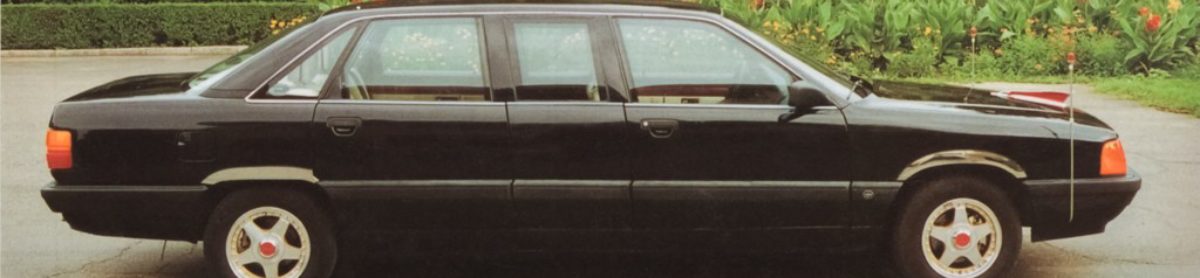

Guangzhou-Peugeot was the third automobile joint-venture in the 1980s, after Shanghai-Volkswagen and Beijing Jeep. The full name of the company was Guangzhou Peugeot Automobile Corporation. GPAC started at the facilities of the Guangzhou Automobile Works in Huangpu, a bus factory.
Negotiations between the bus company and Peugeot took place from 1980. SKD (semi-knocked down assembly) production started in March 1985, with the Guangzhou-Peugeot 504 PUGR (Chinese code GP1030PU) Pickup and the 504 Break.
 GPAC Factory in Guangzhou, 1988. Photo copyright Erik van Ingen Schenau.
GPAC produced 200 units of the 504 pickup in 1986, 2715 units in 1987 and 6000 in 1988. The number of 504 breaks, skd assembled, was very limited.
 Guangzhou-Peugeot 504 break, photo copyright Erik van Ingen Schenau, Qinghai 1987.
The 505 station wagon was launched in 1986. Production of the 505 station wagon started in 1988, the car available with five or eight seats, named 505SW5 (GP7201SW5) and 505SW8 (GP7200SW8). GPAC continued the 504PU, the only car they made for 12 years. .


The production figures of the 504 pick up were; 1990: 2650, 1991: 4476, 1992: 4994, 1993: 4052, 1994: 1241, 1995:1116, 1996: 22, 1997: 455, 1998:367.

The engine was the Peugeot 1971cc XN1A. This imported French engine was also in use in all the 505 models.
At least two local companies started to make a crewcab (double row of seats) version of the 504 pickup. They were the Guangzhou Yangcheng Auto Works and the Guangzhou Automobile Works. (yes, the partner in the joint venture!)

In 1990 production of the Yangcheng GZ121 started, later named YC1021QS. Guangzhou Auto Works produced the Zhujiang (Pearl River) GZ1020 and GZ5020X.

Because of the bad quality of these crew cab pickups, GPAC sent a couple of them to France to let them tested by the Peugeot factory. The result was so bad that GPAC decided to make a crew cab pick up of their own, with a strengthend body, to avoid the cracks the tested vehicles showed.

One of the reason to do this was that owners of the Yangcheng and Zhuhai pick ups replaced the original badges by Peugeot badges, the status of having a Peugeot was higher than a local product. So the poor quality hit back at Peugeot, people thought it was a Peugeot that broke.


The first sedan, the Guangzhou-Peugeot 505 GL, 505QL and 505SX, designated GP7202, was made from 1990-1997.


Production figures of the 505, sedan and station wagon;
1990: 5666, 1991: 12228, 1992:15410, 1993: 16765, 1994: 4485, 1995: 6936, 1996: 2522, 1997: 1557: 1998: 2942.
Also in those years, GPAC tested also the Dangel 4×4 conversions of the 504 pickup and the 505 station wagon. I suppose they made some of them . There was no real serial production.
 Guangzhou-Peugeot 505 Dangel 4×4 station wagon prototype, at the factory site in 1988. Photo copyright Erik van Ingen Schenau.
From 1992-1996 a version called 505 Arab was specially made for export to the Middle East.

At the end of the 1990s there were more and more problems to continue the company. The Chinese side had several grievances:
- the Peugeot company delayed the localization of the parts, because it was more provitable for Peugeot to sell the French parts in stead of making them cheaper locally.
Recently I found figures about the localization, in a Chinese publication, called “History of the China Automotive Industry, 1991-2010”, published by the China Machine Press in January 2014.
The figures are from 1995. We go from less localisation to the most:
1. Dongfeng Fukang 26%, 2. FAW Audi 41%, 3. FAW Jetta 62%, 4. Guangzhou-Peugeot 5-seats 78%, 5. Beijing Jeep Cherokee 82%, 6. Guangzhou-Peugeot 8-seats 84%, 7. Tianjin Xiali 3 vol. 85%, 8. SVW Santana 89% and Tianjin Xiali 2 vol. 89%.
Conclusion: nothing wrong with GPAC: they were doing well, they were in the top group of around 80-90%. - the government regulations required that GPAC would make its own engines.
This is something that Peugeot did not want: they delivered all the engines for the 504 and 505 themselves. They even supplied Yangcheng and Zhuhai pickups with French engines. The selling of the French engines was a main source of income for Peugeot. - the Peugeot company did’t invest enough in GPAC.
The Chinese were spoiled by the hugh investor Volkswagen-Audi. In contrast, they regarded the French as greedy, the French tried to make money without much spending.
At the French side, there were also sensitive matters
1. The Chinese partner had let their own companies copy the GPAC models.
The whole adventure with the locally built crewcab versions of the 504 pickup had cost Peugeot a lot of money.
2. the Chinese authorities blocked the replacement of the old range of vehicles:
In France the 504 was introduced in 1968, the 505 in 1979. Peugeot wanted to make the 405 (1987) and 605 (1989). The Chinese wanted the newer 406 (1995). Citroën had met the same problems when they suggested to make the AX in Wuhan, the Chinese wanted the very new ZX.
Besides of all these differences, there was also something that happened outside the joint venture: In 1992 France delivered 60 Mirage fighterjets to Taiwan. China was not happy and this had a strong influence at the relations; the French consulate in Guangzhou was closed and the government forbid Chinese government agencies to buy Peugeots. The Peugeot 505 was easily set aside by the FAW Audi and later by the Shanghai VW Passat.

Initiatives to make small series of Peugeot 405 and 605 had taken place semi-legally by GPAC.


 Guangzhou-Peugeot 405, photo internet.
And then, in 1997, Peugeot decided to stop. The cooperation was never a success. Selling of the quite expensive cars always had been a problem. Volkswagen was doing much better than Peugeot.
Guangzhou immediately had a replacement for Peugeot: Honda Motors from Japan, theytook over the French shares, which Peugeot had sold to the Guangzhou Municipality for 1 French franc.
The cars still in stock were sold, even in 1998. There were newspaper articles that they were sold under another name: Tianyang. And the designation changed; 504 pick up: GP1020 and GP1030; 505 sedan: GP7220A and GP7222; 505 station wagon: GP7200 and GP7222C.
There were even design studies of the 505 sedan with a changed grille.


I don’t know if they ever sold cars with this grille, I have never seen one.
So Peugeot disappeared from China, but Peugeot came back, in April 2004, when the Peugeot 307 sedan was introduced by the Dongfeng-Citroën company in Wuhan.
Read more:
https://k.sina.com.cn/article_7074268184_1a5a8c418001011sww.html
https://www.yoojia.com/article/10041227612169545561.html
https://www.linkedin.com/posts/yue-ma-32902a10_the-rise-and-fall-of-guangzhou-peugeot-a-activity-7415904460096331776-4frA/
https://baijiahao.baidu.com/s?id=1828446017198855504&wfr=spider&for=pc
from my friend Leo Breevoort:
https://carnewschina.com/2023/05/21/the-big-read-gac-1-4-guangzhou-auto-industry-before-gac/ and https://carnewschina.com/2023/05/28/the-big-read-gac-2-4-the-road-to-success/.
from my friend Tycho:
Guangzhou-Peugeot 505 SX2 Sedan In Black On The Market In China
This Peugeot 505 SX sedan was a rare daily-driver survivor in China’s Capital
Very good Erik! Finally – a comprehensive history of Guangzhou Peugeot is on the internet. I was always very intrigued by these but info was scarce. Great job!
About Dangel Peugeot, one was caught running around China pretty recently: https://platesmania.com/cn/nomer14852721